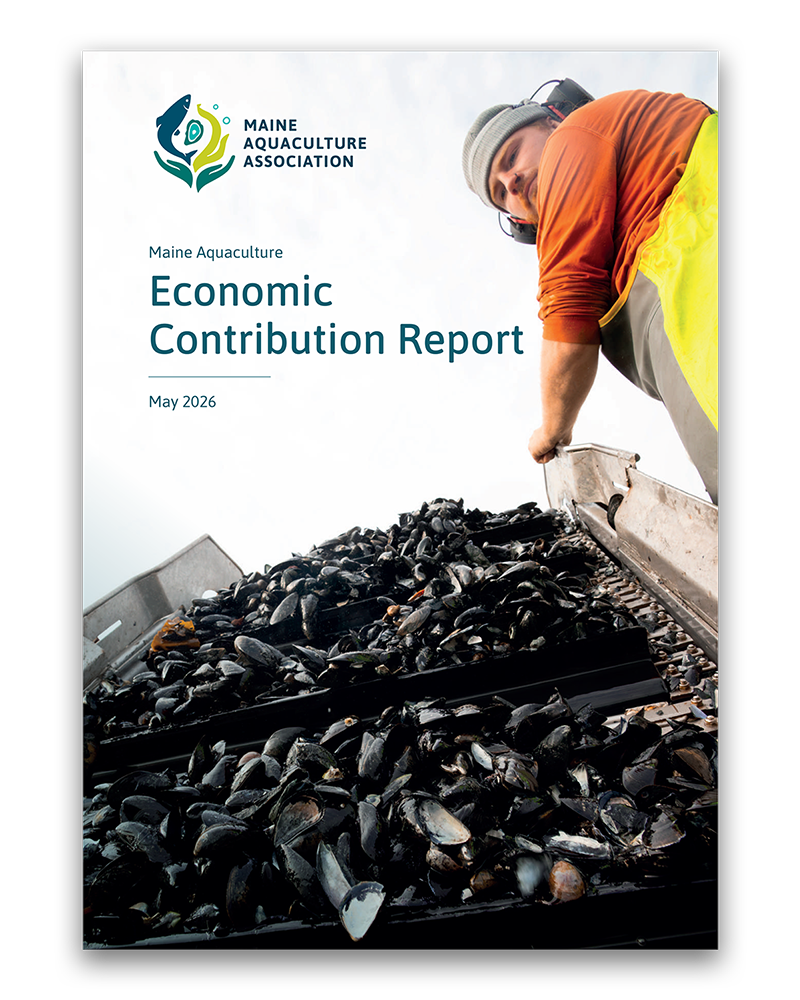
Maine Aquaculture Economic Contribution Report (2026)
Aquaculture has grown into one of the leading sources of Maine seafood, and that growth remains steady according to the recent Maine Aquaculture Economic Contribution Report. The report studies the growth of the Maine aquaculture sector between 2014 and 2023. Aquaculture contributes over $208 million to the Maine economy and adds 1,720 jobs to our workforce. The sector consists primarily of finfish, shellfish, and seaweed farmers, but also includes processors, transportation providers, storage providers, service providers, retailers, boat builders, researchers, non-profits, and many more.
Executive summary and key data points below
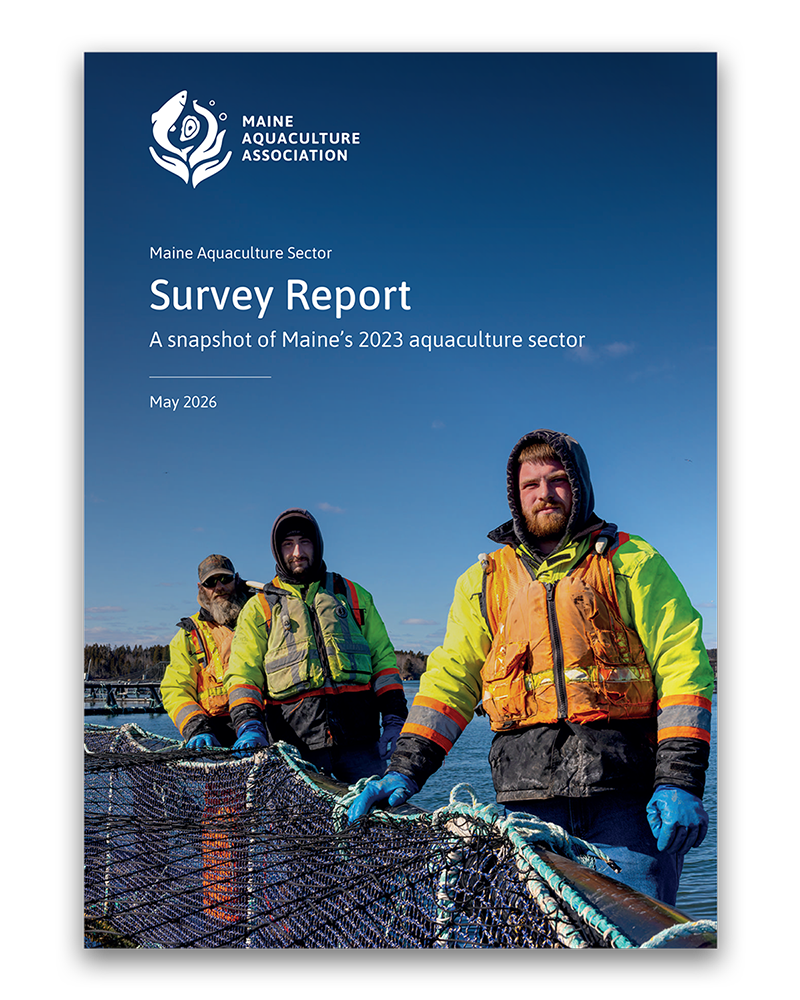
Maine Aquaculture Sector Survey Report (2026)
The Maine Aquaculture Sector Survey Report uses farm-level data from a 2024 sector-wide survey to shed light on the businesses that make up the sector. The report includes detailed information and discussion on business revenues, expenses, employees, demographics, and outlook. Businesses were asked about their employees, expenditures, revenues, and the outlook of their businesses. The survey model and responses are described in detail in this document.
Executive Summary
Maine aquaculture has become woven into the fabric of the coastal and rural communities where farms are located.
From 2014 to 2023, the total economic contribution of the Maine aquaculture sector increased by 51% from $137.6 million to $208.1 million, and the total number of jobs increased by 60% from 1,078 to 1,720.
Maine’s aquaculture sector has a direct economic contribution of $105.9 million in output, with an additional $57.5 million in output from indirect (supply chain) effects and $44.7 million in induced (household spending) effects.
If the direct economic contribution of lobster is excluded from calculations, the aquaculture industry’s direct contribution of $105.9 million represents 69% of seafood value in Maine.
The shellfish and seed subsector more than tripled in sales revenue from 2014 to 2023.
The top three species by sales revenue are Atlantic salmon, eastern oysters, and blue mussels.
Annual aquaculture production values vary considerably in part due to site rotation and fallowing routines. The current study was conducted during a period when finfish production was at a low point in its normal three-year rotation cycle, which also occurred in the 2017 study. This, paired with substantial finfish losses in 2023 due to unusual environmental conditions, significantly reduced the level of economic contribution found in that sub-sector and thus the contribution of the greater sector statewide. The finfish estimates are conservative. Subsequently, the total estimates in this study are also conservative. Total finfish production contributions in a strong year could be well over 50% higher than reported here, putting total annual aquaculture contributions to Maine over $265 million.
The majority of Maine aquaculture jobs reported were full-time, year-round positions.
This is a sector of small, beginning farmers. 35% of businesses have been operating for fewer than 5 years, 44% have been operating for 6-10 years, and only 21% have been in business for more than ten years.
83% of respondents held 20 leased acres or fewer, and most respondents held more than 5 leased acres.
There is substantial optimism in the aquaculture sector with 77% of respondents projecting sales revenue growth by 2030, with a median sales growth projection of 75% per business. This is likely driven by the cohorts of early and middle-stage businesses, mentioned above, who are growing to find their right size. This also likely drove the sector to triple the shellfish and seed subsector.
Primary lease holders had high levels of educational attainment, with 89% having a four-year degree or higher. 69% of the respondents were between the ages of 40 and 69 years old.
The aquaculture workforce is also well-educated, with an estimated over 70% holding a four-year degree or higher. The workforce skews younger than leaseholders, with the majority of the workforce under 50, and the largest segment of it under 35.
Those who identified as women or nonbinary comprised 29% of primary leaseholders and 24% of the workforce, respectively. That is over 4x higher than the percentage of female commercial fishers and owners across the U.S. (Posadas, 2025)
80% of producers sell their product to wholesalers or distributors. The largest farm-level sales channels by volume, in decreasing order, are: wholesalers/ distributors in Maine, direct to consumer in Maine, and split between U.S. wholesalers/distributors beyond Maine and restaurants and markets in Maine.